
What are jiggers, and why do they keep children out of school?
Jiggers are tiny sand fleas that burrow into bare skin, usually the feet, and cause a condition called tungiasis. In rural Uganda, they attack children who walk barefoot, leaving them in too much pain to walk, learn, or play.
Sole Hope has spent 16 years working to end this. We are one of the only organizations in the world dedicated to jiggers at this level. From hands-on treatment and community education to locally made protective shoes and mental health care. The video below shows what jiggers actually do, and what freedom from them looks like.
Tungiasis is classified as a neglected tropical disease (NTD). It affects millions of people who receive almost no global attention or funding.
Children ages 5 to 14 and the elderly carry the highest burden. In some Ugandan communities, more than 60% of residents are infected at once.
Jiggers cause pain, disability, shame, and school dropout. Left untreated, they can lead to gangrene, tetanus, and death.
What are jiggers?
Jiggers are sand fleas, scientifically known as Tunga penetrans. The female flea seeks out bare skin, burrows in, and anchors herself to a blood vessel. This is tungiasis.
Within days, she swells to the size of a small pea as she fills with eggs. The lesion appears as a white or yellow bump with a dark center. A single child can carry dozens or even hundreds of fleas across their feet, between their toes, and under their nails. Open wounds invite bacteria. Secondary infections, including tetanus and gangrene, can follow.
Over roughly three weeks, each flea expels up to 200 eggs into the surrounding soil, then dies in place. Without intervention, the cycle repeats.
Where jiggers thrive
Jiggers live in dry, loose soil: dusty ground, sandy paths, cracked earthen floors. Anywhere people walk barefoot is a risk. Children who play outside, families who sleep on dirt floors, and households that share space with animals are most vulnerable.
The conditions that create jigger infestations are the same conditions that create poverty: dirt floors, no shoes, no nearby health care, and no way to break the cycle.
Prevalence recorded in some Ugandan communities, with more than 6 in 10 people infected at the same time
Eggs a single flea deposits before dying, seeding the soil for the next infestation
Pooled prevalence across sub-Saharan Africa, affecting hundreds of millions of people in poverty
How jiggers affect a child and their family
Jiggers are small. Their consequences are not. The damage reaches every part of a child's life.
Physical
Severe pain, itching, swelling, and open wounds. Children cannot walk, sleep, or play. Severe cases lead to permanent tissue damage.
Psychological
Shame, fear, and loss of confidence. Children describe feeling dirty, forgotten, and unloved. Anxiety and depression are common.
Social
Children are teased, avoided, and sent home from school. Families face isolation and judgment. Communities fracture around stigma.
Spiritual
In some communities, jiggers are believed to be a curse or punishment. Children may feel abandoned, even by God.
Why are jiggers so neglected?
Jiggers affect people the world already overlooks. The disease is painful, visible, and solvable. Yet it receives almost no global funding or attention.
For years, tungiasis did not appear on official global disease lists. No data. No funding. No programs. Children kept suffering.
Cases cluster in rural communities with the weakest health systems. That means little data gets collected. And without data, there is no pressure on governments or funders to act. It is a self-reinforcing cycle of neglect.
This is the gap Sole Hope steps into every day.
How jiggers are treated
There is no pill that removes jiggers. No quick fix. Each flea must be carefully extracted by hand using sterile instruments. It is a delicate procedure that requires training, the right tools, and proper wound care to prevent further infection.
In the communities we serve, most families try to remove jiggers with thorns, pins, or dirty needles. This usually makes things worse, causing infection, rupturing the flea, and spreading eggs into the wound.
At Sole Hope clinics, trained Ugandan staff:
- Wash and gently soak feet to soften tissue
- Remove jiggers with sterile instruments
- Dress wounds and apply antibiotic care
- Provide pain relief and follow-up support
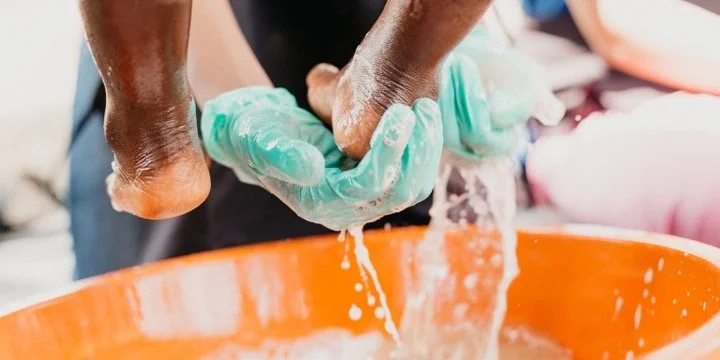
Severe cases receive extended care at the Hope Center in Jinja, which includes housing, ongoing medical treatment, and counseling.
How jiggers are prevented
Prevention is straightforward, but only if you have the resources. A single pair of closed shoes changes everything. So does a sealed floor. So does knowing what jiggers are and how to stop them.
Sole Hope's prevention work includes:
- Distributing locally made protective shoes
- Teaching families how jiggers spread
- Educating schools and communities
- Supporting floor improvement in homes
- Training community health workers
Every clinic visit is an opportunity to equip a family with knowledge they will carry home and pass on.
Common questions about jiggers and tungiasis
What are jiggers?
Jiggers are sand fleas, scientifically called Tunga penetrans. The female flea burrows into bare skin, most often on the feet, and causes a parasitic skin disease called tungiasis. She swells as she lays eggs, creating a painful, raised lesion.
Are jiggers the same as chiggers?
No. They are completely different. Chiggers are mites that bite and move on. Jiggers are fleas that embed permanently in the skin and must be physically removed. The names sound similar, but the conditions are unrelated.
Are jiggers contagious?
No, not from person to person. Jiggers come from infested soil and sandy ground where people walk barefoot. The risk is environmental. You cannot catch jiggers from touching someone who has them.
Can jiggers kill you?
In severe cases, yes. Untreated tungiasis can lead to secondary bacterial infections including tetanus, gangrene, and sepsis, which can be fatal. Outbreaks in Uganda have caused deaths, especially among children and the elderly. This is why early treatment matters.
How are jiggers removed?
Each flea must be carefully extracted using sterile instruments. There is no oral medication that treats tungiasis. If the flea ruptures during removal, which happens often when families use thorns or dirty pins, it causes severe inflammation and can spread infection. Proper removal requires training and the right tools.
Can jiggers be prevented?
Yes. The most effective prevention is wearing closed shoes. Sealed or swept floors, avoiding barefoot contact with infested soil, and community education all reduce risk significantly. Sole Hope addresses every one of these factors.
Where is tungiasis most common?
Tungiasis is most prevalent in rural communities in sub-Saharan Africa, particularly Uganda, Ethiopia, Kenya, Tanzania, and Nigeria, as well as parts of Latin America and the Caribbean. It is closely tied to poverty, barefoot living, and dirt floors.
Why is tungiasis called a neglected tropical disease?
Tungiasis is classified as a neglected tropical disease (NTD) because it overwhelmingly affects the world's most marginalized communities, receives almost no global research funding, and was excluded from official disease lists for decades, despite causing widespread suffering.
How many people have jiggers in Uganda?
Prevalence varies by region. In some communities in northeastern Uganda, studies have recorded infection rates above 60%. In eastern Uganda, 1 in 5 households reports active infestation. Jiggers remain a serious and ongoing public health challenge across rural Uganda.
What does Sole Hope do about jiggers?
Sole Hope operates Walk In Freedom Clinics inside government hospitals across Uganda, provides mobile outreach to remote communities, distributes locally made protective shoes, offers mental health support, and runs community education programs. Over 16 years, we have treated more than 372,000 patients and helped the Busoga region achieve an 80% reduction in jigger rates.
You can be the reason a child walks free.
Jiggers are painful, preventable, and treatable. The only thing standing between a child and freedom is access to care, and people willing to show up for them. For $35, one patient is completely treated. Most problems you cannot solve for $35. This one you can.
You found this page because you wanted to understand. That curiosity can become something more. Zero jiggers. Nothing less. Everyone walking free.